Birds, Beadgrass, and Biodiversity: A Look Inside an Airport Rare-Species Protection Project
Nov. 30, 2025
6 min read
 6904e317c483091d281c0b71 Birds And Beadgrass 4
So much of New England, and other parts of the country, have in recent decades seen forests steadily reclaim grasslands once cleared for farms and pastures back in the 19th Century. That means that in many places airports have become some of the prime, remaining habitat for rare grasses and grassland plants and the birds, pollinators, and other wildlife that depend on them.
What that means for airport managers: A strong chance you’ll be required to conduct a rare species assessment and implement a protection plan before future major construction work like repaving, extending, or adding runways and taxiways.
It may sound challenging, but what we learned from a recent project at the Groton-New London Airport in Connecticut is that, with effective advance planning, rare species work need not have any negative impact on the schedule for completing airfield work. Some very precise redelineation of the “work zone” for the project may be able to significantly reduce the amount of habitat requiring protective action. And once you have identified and relocated affected species out of remaining work areas and into appropriate new locations within the airfield, these species may turn out to flourish as never before.
Some background: Groton-New London (IATA: GON) is a state-owned, public use airport about three miles south of the town of Groton, located on the Poquonnock River, close to where the river enters Long Island Sound. First opened in 1929, the airport was adopted for U.S. Army and later U.S. Navy use during World War II. The airport has not hosted scheduled passenger service since then-USAir moved out in 2004, but it is maintained to support Civil Air Patrol flights and the return of commercial service at any time. GON has frequently been used to serve visits by U.S. presidents and other dignitaries to the nearby Coast Guard Academy. The 489-acre airport has two asphalt paved runways, at 5/23 and 15/33 orientations, 5,000 feet long and 4,000 feet long respectively.
Connecticut is among many states in the Northeast with extensive policies and regulations in place to protect rare species. In the case of Groton-New London Airport, the Connecticut Department of Energy & Environmental Protection identified 10 state-listed plants expected to be found at the airport site, along with a species of state-listed stem borer moth that counts another common plant species as a preferred host habitat.
These plants are identifiable by flower or fruit or in leaf at various times between the beginning of May and the end of October, but we were able to identify times in mid-June and mid-August when some combination of all of them would be identifiable, reducing the need for field inspections to just two.
Preparation for botanical surveys included coordinating with airport staff to make sure the survey areas went unmowed for at least 14 days and to have escorts available to ensure the safety of biologists working on the active airfield.
After two rounds of field inspections, we had identified a total of 578 listed plants that would need to be protected as required by state regulations. We also identified ideal areas for transplanting affected plants, incorporating botanical conditions such as similar sun, shade, and soil conditions and water retention levels to where the plants were growing, and airport needs like areas that can be maintained by mowing, but outside of the Safety Areas where the plants were less likely to be an issue for future airport projects.
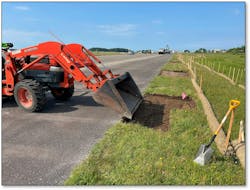
By very precisely redrawing the contours of the proposed work zone (inset figure shows an example section), however, we and airport officials were able to reduce the number of impacted plants by nearly 60 percent, down to 241. This greatly simplified the work needed for transplantation. To the biggest extent possible, we tried to move plants by having excavators carefully remove and replant large patches of turf, avoiding the challenges around trying to remove and successfully replant individual plants or clusters of plants. Transplanted sod block locations were collected with a GPS unit for monitoring purposes (to track success), and botanists using walkie-talkies closely coordinated the movement and replanting of sod blocks to ensure they went to their designated locations. The airport and construction staff were diligent about sending a 10-wheeled watering truck out to water the planted locations consistently during a hot, dry, windy summer. For aircraft safety, we had to be sure that none of the transplanted sod caused more than a 2-inch change in the vertical elevation of the affected Runway Safety Areas.
Five State-listed bird species which Connecticut identified as potentially making the airfield home were the Bobolink, Eastern Meadowlark, Grasshopper Sparrow, Horned Lark, and Savannah Sparrow. During our field work, we saw and/or heard three of those species. To determine if any were actually nesting in the work area, we conducted a low-impact “rope-drag” survey, with two scientists holding a one-inch lightweight cotton rope and dragging it across the top of the grass—enough agitation to flush out any nesting birds to help identify the locations of nests, but not so much rope weight or impact that it would damage nests or eggs. The rope-drag exercise confirmed that none of the observed species we were looking for had nested in the work areas at the Groton-New London Airport that could be harmed by construction crews.
Later in the year, with the taxiway work complete, we returned to survey how the listed plants were faring. What we found was that they were not just surviving, but thriving! We observed more listed plants in the transplant areas than the 241 plants had been moved just a season earlier. Of 44 patches of Field Beadgrass plants we’d moved, only one had less than a 100 percent survival rate, and others had survival rates in excess of twofold in number. At a high level, our airport client, our team and the CT regulators were pleased of the initial results which clearly showed that we helped preserve these species without sacrificing the project requirements. Additional monitoring will be conducted to determine long-term success.
Our main takeaway: Airport managers undertaking major runway and taxiway improvements often have questions and concerns about compliance with applicable environmental regulations. With plenty of advanced planning and use of the right identification and mitigation practices, protecting species on your airfield can be accomplished without interfering with your project goals. It can also help these species, like departing aircraft, take off and soar.
About the Author
 Erin Haugh
 Erin Haugh
Ecologist and Project Manager
Erin Haugh is an ecologist and project manager for GZA GeoEnvironmental.
 Susanna Sousa
 Robin Casioppo
Robin Casioppo
Senior Ecologist
Robin Casioppo, CWB, PWS, CESSWI is a senior ecologist for GZA GeoEnvironmental.
Sign up for our eNewsletters
Get the latest news and updates