St. Louis Airports Highlight Major Growth, Infrastructure Expansion and Record Activity at 2025 Take Flight Forum
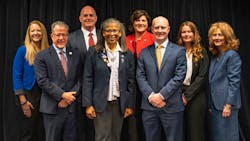
L to R: Dr. Jennifer Kephart, Superintendent of the School District of Washington, Missouri; John Bales, Director, Spirit of St. Louis Airport; Darren James, Director, MidAmerica St. Louis Airport; Yolandea Wood, President of the Hugh J. White Tuskegee Airmen Chapter and Director of the Organization of Black Aerospace Professionals’ ACE Academy serving the St. Louis region; Rhonda Hamm-Niebruegge, Director, St. Louis Lambert International Airport; Daniel Adams, Director, St. Louis Regional Airport; Sandy Shore, Director, St. Louis Downtown Airport, and Mary Lamie, Executive Vice President of Multimodal Enterprises for Bi-State Development.
The St. Louis Regional Freightway convened leaders from five of the region’s airports on Nov. 13 for the 2025 Take Flight Forum, where directors outlined significant operational gains, air service wins and long-range capital programs shaping aviation growth across the bi-state region.
Mary Lamie, Executive Vice President of Multimodal Enterprises for Bi-State Development, opened the forum by emphasizing the economic importance of the region’s aviation system. Lamie, who also leads the St. Louis Regional Freightway and its Aerospace and Aviation Task Force, noted that airport activity continues to play a central role in regional competitiveness.
St. Louis Lambert International Airport Director Rhonda Hamm-Niebruegge highlighted rising passenger and cargo volumes and detailed long-sought international service expansions. British Airways will begin service to London in April, and Lufthansa will increase its Frankfurt service from three to five weekly flights. Cargo activity has also doubled its share of the market over the past five years.
Hamm-Niebruegge provided an update on Lambert’s multi-phase, $3 billion consolidated terminal program. Airfield maintenance work is advancing under the first phase, with terminal design expected to reach 30% by January, 60% by June and 90% by the end of 2026. She noted broad regional support for the project as planning moves toward airline approval for construction.
MidAmerica St. Louis Airport Director Darren James reported strong year-over-year performance, including a 27.5% increase in enplanements through October. Allegiant’s service continues to anchor the airport’s leisure offerings, including a recently launched route to Gulf Shores. James also underscored progress on the MetroLink extension set to connect MidAmerica with Lambert by summer 2026, along with terminal enhancements and development of a new general aviation facility and federal inspection station.
James also noted activity surrounding Boeing’s MQ-25 Stingray production facility, where testing is underway ahead of anticipated initial flights later this year.
John Bales, Director of Spirit of St. Louis Airport, detailed completion of the airport master plan and a slate of major capital projects including a full runway reconstruction and plans for a new general aviation terminal. He described recent tenant-driven investments, including a 90,000-square-foot hangar project and a private initiative to construct 28 new hangars to address regional demand. Bales also highlighted the airport’s educational programs, including the STEM-focused Spirit of St. Louis Airshow and the Red Tail Cadet Program, which recently celebrated its first all-female graduating class.
St. Louis Regional Airport Director Daniel Adams reported a 40% increase in flight activity over the past year driven largely by the return of flight training. Adams noted a $1 million rehabilitation of Taxiway Bravo planned for spring 2026 and early discussions with the FAA on a potential new control tower. He also pointed to workforce training partnerships and tenant expansions, including West Star Aviation’s growing maintenance and training footprint.
Adams previewed next summer’s Air Race Classic, an all-female piloted competition expected to bring about 60 aircraft and 120 participants to the airport ahead of the four-day, 2,300-mile race.
St. Louis Downtown Airport Director Sandra Shore outlined progress on a new terminal project, supported by $3.6 million in recently awarded state funding, and a new taxiway representing a $25–30 million investment. Shore cited tenant expansions, including hangar construction and maintenance shop growth, as evidence of sustained demand. She noted Gulfstream’s recent $30 million facility expansion and addition of 200 jobs, underscoring the region’s concentration of aerospace activity and collaborative workforce pipeline.
Throughout the forum, all five airport directors emphasized the importance of regional cooperation, both in operational matters and workforce development. Lamie reiterated that collaboration among the airports strengthens the region’s ability to retain talent and support growth across multiple aviation sectors.
The event concluded with a panel of STEM and flight-training leaders highlighting programs aimed at increasing student engagement in aerospace careers. The 2025 forum, themed “STEM to Sky!,” marks the fourth annual gathering spotlighting regional airport investments and efforts to strengthen the next-generation workforce.