Create a FOD-mindful Work Culture
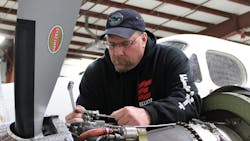
In this edition of Director of Maintenance Discussion, Jason Staver, director of maintenance for Elliott Aviation – Moline, IL, joins AMT to talk about the dangers of and how to prevent foreign object debris and damage (FOD).
AMT: To start, let’s define what FOD is and isn’t.
Staver: FOD is foreign object debris and it occurs usually when someone’s careless or something falls apart on the aircraft.
AMT: What makes it so dangerous?
Staver: It can be ingested into an engine and FOD out an engine. It can get stuck in places where it’s not supposed to be and it could jam controls, it could do a lot of things. We actually see a lot of FOD in the floorboards of our aircraft. Just carelessness of not keeping track of stuff and items falling through into the belly of the airplane.
AMT: Can you share some examples what damage caused by FOD can look like?
Staver: Well, it kind of depends on what the foreign object is. If it goes through an engine, it really doesn’t matter what it is. It goes through the engine and it just tears things up. Beats up the compressor blades, if it gets far enough in, it can actually chew up and beat the internal part of the engine up too.
AMT: What are some of the more likely kinds of FOD you’ve to run into?
Staver: It would be a nut and bolt or piece of safety wire, or I’ve seen pieces of metal on the runway that were dropped from a maintenance truck. It’s anything that’s not supposed to be there. Then under the floorboards, I’ve seen playing cards, I’ve seen pens and pencils. The small little liquor bottles – I’ve seen them rolling around in the belly of the airplane. Over 30 years, I’ve seen a lot of stuff.
AMT: Are there any noteworthy or memorable cases of FOD that come to mind?
Staver: We had a Citation jet in several years ago that it picked up something metal on a runway and it had a perfect spiral. The damage on the blades on the front compressor blades was in almost a perfect spiral all the way to the outside of the engine. So it looked like it hit maybe the center cone and then just drug around all the blades, all the way around in a perfect circular shape, before it went through the engine and then out the bypass.
AMT: Could you salvage the engine?
Staver: We actually took the engine and sent it in for repair. They did salvage the engine. They just needed to put a new compressor wheel with new blades and then fix some of the damage that was in the downstream area of it. So it was fixable. Most everything’s fixable. It just, when it hits, it’s usually a bad thing because it costs a lot of money.
AMT: Let’s turn now to preventing FOD. What’s your guidance?
Staver: In general, you pick up after yourself. I tell my guys, cleanliness is next to godliness. We need to make sure we pick up our loose hardware, safety wire clippings. We even try to sweep the floor around the airplane before the airplane moves out of the hangar. Just general housekeeping. We do a lot of vacuuming and cleaning of things. And then at Elliott, we have FOD buckets all over the hangar. Yellow FOD buckets. If we’re working inside the airplane, we’ve got the yellow minnow buckets. We call them FOD buckets inside but they’re just minnow buckets that we can drop stuff into it. It’s got a spring door on it so nothing can escape.
We take it very seriously. We actually do a FOD walk once a week out there on the ramp even just to try to mitigate loose rocks in the ramp and, of course, anything else that we would find that would drop off one of our tugs or other pieces of equipment to drive around too. As the snow melts, it’ll even become even more because you’d be amazed at what the snow plows drag in.
AMT: Is there anything else you’re doing or using to catch FOD?
Staver: We do use, underneath our floorboards, we use three sets of eyeballs. It’s not necessarily exactly for FOD, but it works for the same thing. When we’re done working underneath the floorboards, there is always another production inspector that comes in and he looks and goes through things. And then also our quality control inspector comes through and does a check of the area also.
AMT: How do you keep your eye and mind sharp to notice and pickup FOD?
Staver: It’s not real hard. You’re looking for anything that doesn’t belong. So if you’re out on the ramp and you’re looking at concrete, only concrete should be there. So now you’re looking for anything. I know our ramp and all the cracks, we’ve got tar pushed into ‘em to try to hold loose anything underneath. We’ll find chunks of tar that have pulled up. We’ll find big pieces of a rock that have crumbled away from the corners. We picked that stuff up. We’ve actually even got a little handheld battery operated vacuum cleaner so we can get, you know, down in the cracks good. But basically it's not real hard. Anything that doesn’t belong, does not need to be there.
AMT: What tips do you have to create a FOD-mindful work culture?
Staver: The biggest thing that we do is, is every time we find something that could have been caused by FOD, we make sure everybody sees it. That way they understand the importance of it. We continually train all year long, toolbox talks, et cetera and so forth like that. And FOD gets brought up very often in those toolbox talks or any of that other training. I think that it’s just kind of one of those things that everybody keeps hitting the high points of it and it just keeps it ingrained and entrenched in the back of everybody’s head.
About the Author
 Walker Jaroch
Walker Jaroch
Editor
Contact: Walker Jaroch
Editor | AMT
+1-920-568-8399
>> To download the AviationPros media kits, visit: Marketing Resource Center
>>Check out our aviation magazines: Ground Support Worldwide | Airport Business | Aircraft Maintenance Technology